TL;DR
- ERC-8004 gives an AI agent three things: a name, a description, and reviews. You can write the first two by yourself. Only a review needs somebody else. So only reviews measure adoption.
- There are 558,094 reviews across 28 chains. 300,692 of them (53.9%) are about one agent: the BOTCOIN mining coordinator, written by the 57 wallets that mine for it, with a score of exactly 1 every time.
- That loop stopped on 17 August 2026, so the total is now frozen. The second biggest writer is a cron job that rated 7,556 agents it never hired.
- On Ethereum, where the standard launched, 145 agents out of 50,127 have a review from anything that is not a crawler. 19,900 (39.7%) never wrote a description at all, and 10,000 point at a domain that stopped resolving.
- None of this is a bug. The contracts do exactly what they say, and the spec itself warns that unfiltered totals are easy to fake. The customers just never showed up.
- Real agents do exist. 6 of the 8 agents the explorer promotes answer when you call them, and Toppa on Celo has 602 reviews from 511 different reviewers. That is the scale: tens, against a headline of 418,665.
- Disclosure: I wrote the Starknet integration for ERC-8004 in keep-starknet-strange/starknet-agentic. Starknet's version is the only one that refuses to hand you an unfiltered average. It has 6 agents.
The receipts
ERC-8004 is Ethereum’s standard for giving AI agents an identity and a reputation. It went live at block 24,339,925 on 29 January 2026. By the numbers on its own explorer it has been a hit: 418,665 registered agents across 28 chains, 552,155 reviews, 401,030 “active users.”
I am not neutral here. I wrote the Starknet integration for this standard, the
starknet-identity skill in
keep-starknet-strange/starknet-agentic,
which wraps a Cairo implementation of the
same three registries. I went looking for numbers that would justify work I had already
done.
Instead I read all 558,094 reputation events ever written to the standard. Complete history on Ethereum, Celo and Base, published totals for the other 25 chains. The numbers are real and the contracts are fine. The adoption is not there.
Here is an AI agent with 292,300 reviews and no reviews.
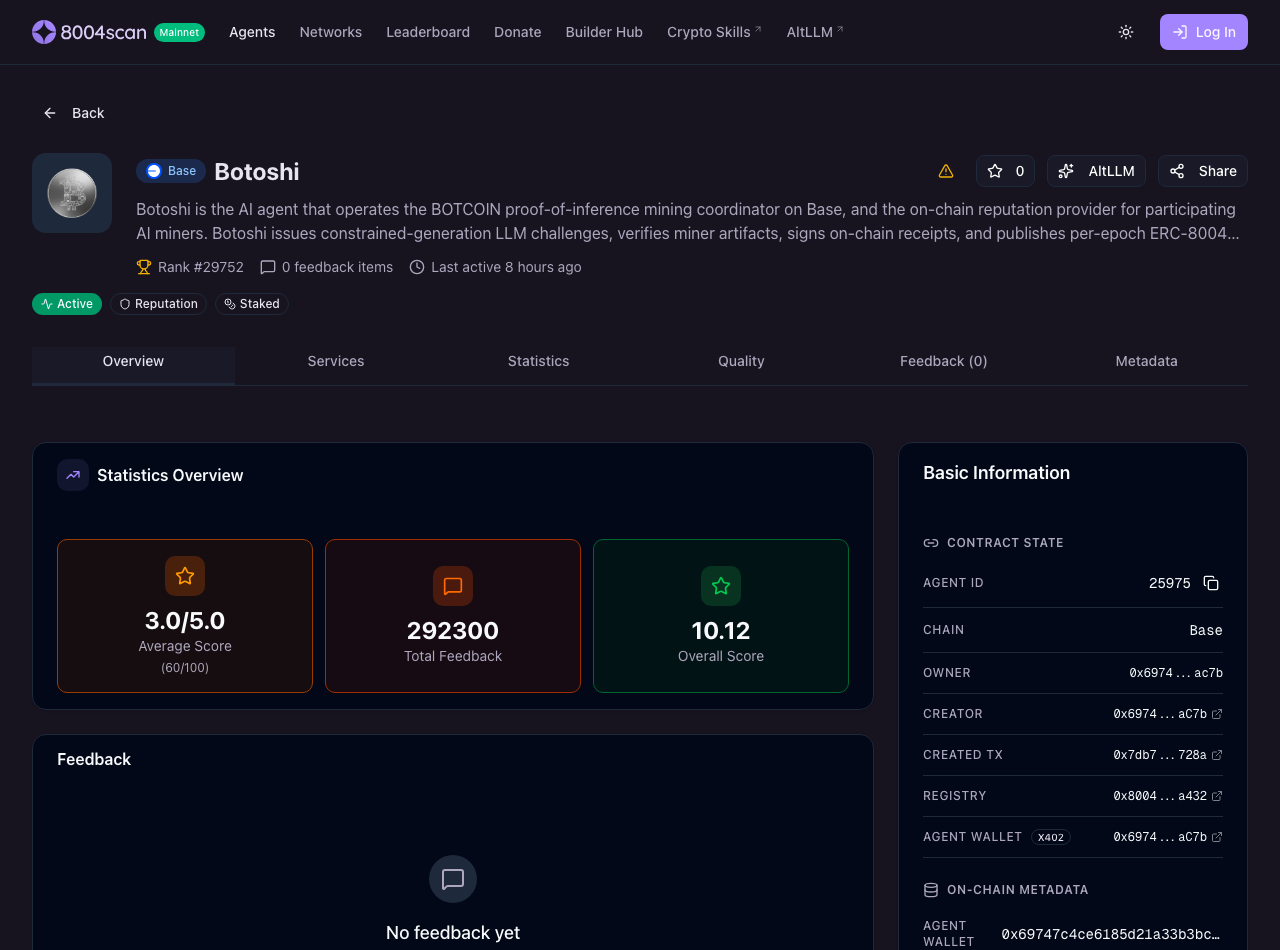
That is the ecosystem’s own explorer. It cannot make its own numbers agree on one screen. It also gives this agent 3.0 out of 5.0, a tidy star rating built from on-chain entries whose value is, every single time, the literal number 1.
What ERC-8004 is
The standard defines three registries, deployed as one contract per chain at the same address everywhere. The whole argument comes down to which one you count.
| Registry | What it holds | Who can write to it |
|---|---|---|
| Identity | The agent as an ERC-721 token, pointing at a JSON file that describes it | The owner, alone |
| Reputation | Reviews: a signed score, tags, the endpoint used | Anyone, about any agent |
| Validation | Third-party attestations (zkML, TEE, staker) | Validators. No EVM chain has published an address for it |
So one of the three legs was never shipped on any EVM chain. One you can write by yourself. One needs somebody else.
That last difference is the whole point of the standard. Minting a name costs gas and takes a second. Writing your own description is free. But you cannot review yourself into a reputation. Somebody else has to show up, use the thing, and say so on chain.
The one number that matters
Which means only one of those three front-page numbers tells you anything about adoption. Here is what the front page counts instead.

401,030 “active users.” The site never says what active means. Set that against what I measured on Ethereum, the chain the standard launched on, where I have every event since block one: 145 agents out of 50,127 have ever been written about by anything that is not a bot. Whatever 401,030 counts, it is not that. It reads like a count of everyone who ever showed up once, with a nicer label.
The middle number, 552,155 reviews, is the one the spec authors tell you not to trust. This is from their own security section:
results without filtering by clientAddresses are subject to Sybil/spam attacks
In plain terms: if you add up reviews without checking who wrote them, the total means nothing, because writing reviews is cheap. That is what the headline does.
The shape of the registrations tells you what kind of number it is. Here is Ethereum, day by day, since launch.
More than half of it is one agent
Base holds most of the standard’s reputation, so I read all of it: 454,196 reviews across 57 block windows, no gaps, and two separate passes that agree exactly. 300,692 of those reviews are about one agent.
Agent #25975 is Botoshi, the one in the screenshot above. Its own description says what it is: the AI agent that runs the BOTCOIN proof-of-inference mining coordinator. The reviewers are 57 wallets that mine for it. The score is 1, three hundred thousand times over.
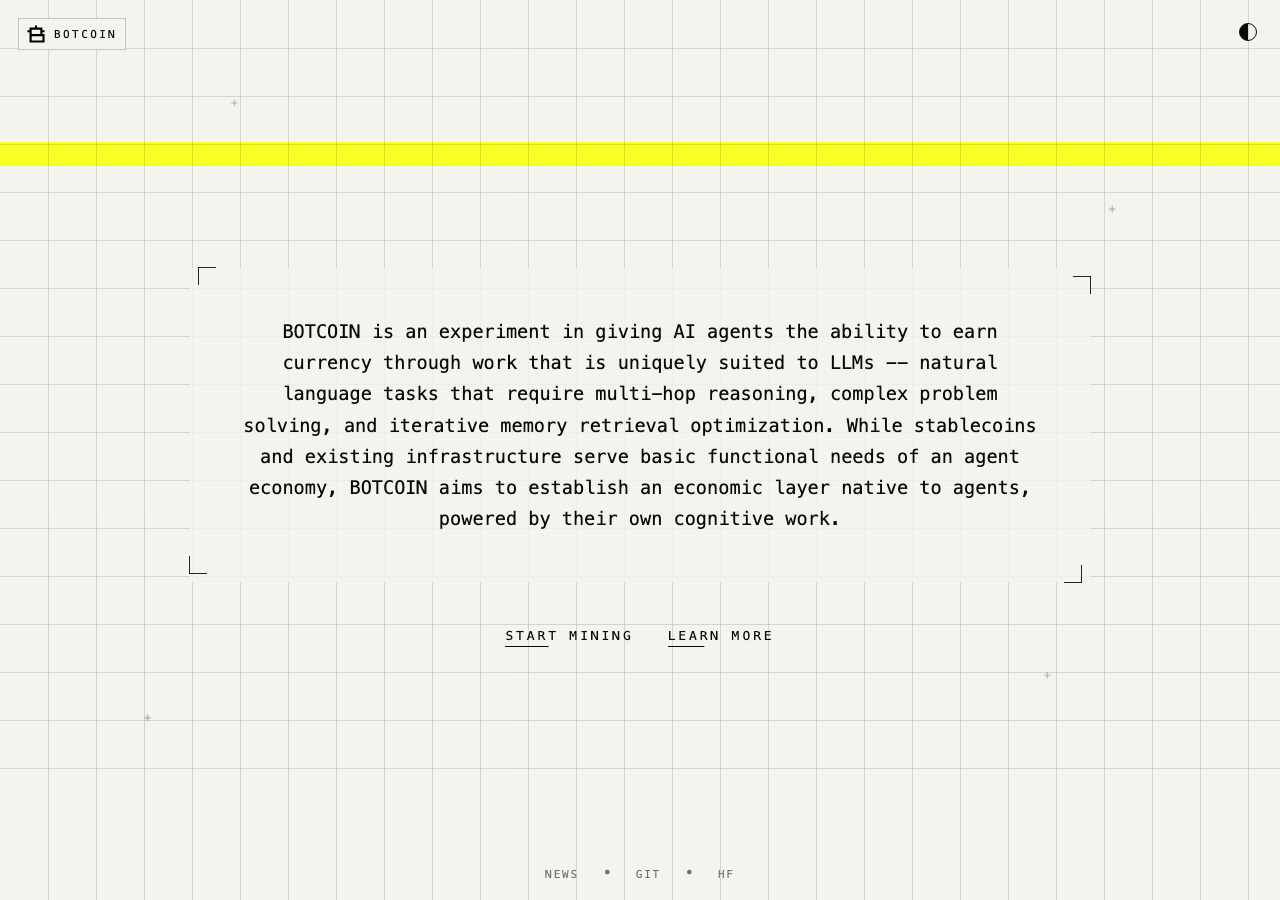
This is not fraud and nobody is hiding anything. BOTCOIN is a mining protocol, and those
miner-vouch entries are mining receipts: the coordinator signing off that a rig did
valid work so it can claim tokens. Writing them to a public log is a reasonable engineering
choice. It is not reputation. No reader of “552,155 reviews” would guess that more than half
of them are one token’s bookkeeping.
So what happens to the headline when the mining stops?
It stopped
As of 18 August 2026 the BOTCOIN coordinator answers every request with HTTP 503 - "Coordinator in claim-only cutover mode." So I bucketed its reviews by time.
The last miner-vouch event landed in Base block 50,108,244, at 22:30 UTC on 17 August
2026. Nothing since. Base’s whole review flow fell with it, from 11,512 in a window to 546.
So 53.9% of all reputation on this standard came from one mining scheme, and that scheme has switched itself off. The headline is not going to grow much from here. It is going to sit there, frozen, getting quoted.
What is underneath
Take Botoshi out and the second biggest source of reputation is a cron job. One address
writes five metrics in lockstep: trustScore, contractRisk, counterparty, activity,
longevity, about 7,556 agents it never hired. You can tell it is automated because the
per-tag counts differ by 18 out of 10,653. On Ethereum, 2,165 of 3,215 reviews (67.3%) come
from liveness crawlers logging that an agent answered the phone.
The registry underneath is thinner still.
19,900 of Ethereum’s 50,127 agents (39.7%) have no description at all. Just a name, nothing to call. 10,000 of them point at one domain.
The bulk registering did not stop after launch either. 5,611 agents arrived on 29 July, 4,388 the next day, and 1,984 on 8 August, against a baseline of tens per day. Whoever is doing this is still doing it.
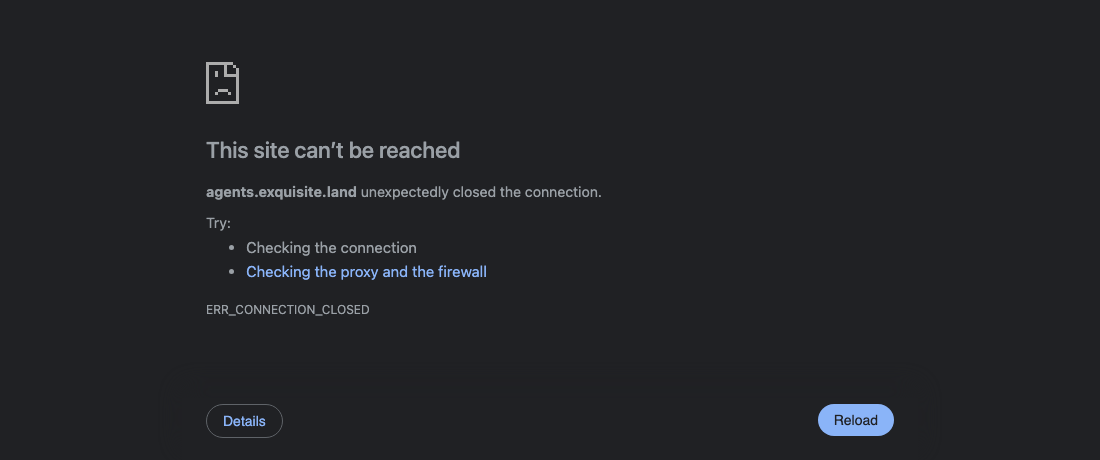
The ones arriving on the morning I looked are not obviously better. This is the “Latest Agents” strip on the same front page, which refreshed while I was reading it.

I traced how one batch of those blank registrations was made, because the method matters
more than the fact. They sit in Gnosis Safe accounts whose owner keys have
never sent a transaction: nonce zero, zero balance, all of them. The registrations came
in as ERC-4337 operations, which is the account-abstraction standard that lets somebody else
pay your gas. A bundler submitted them to the EntryPoint, a paymaster covered the cost, and
each operation packed about a hundred register() calls together. That is 4,571 agents at
effectively no cost to whoever owns them. Somebody built a machine for this.
| Piece of the machine | Address | What it is |
|---|---|---|
| Sample batch | 0x132c8ea5… | One operation, about 100 registrations inside |
| EntryPoint | 0x00000000…a032 | The canonical ERC-4337 entry point |
| Paymaster | 0x77777777…834C | SingletonPaymasterV7, which sponsored the gas |
| Safe factory | 0x4e1DCf7A…ec67 | Created the nine holding accounts |
| Bulk minter | 0xd5d6d96f…a291 | A contract literally named BatchMintAgent, holding 9,989 blank agents |
I checked for the obvious fraud first and it is not there. On both Ethereum and Base, not one review was written by the address that owns the agent. Nobody is doing the lazy version. The padding is subtler: some accounts sign up agents nobody could hire, and a few bots hand out reviews nobody asked for.
| Wallet | Agents | Per transaction | No description | Ever reviewed | What it did |
|---|---|---|---|---|---|
0xde152afb…d336 | 13,175 | 1.8 | 0% | 48 | Three NFT collections. 10,000 point at the dead domain |
0xd5d6d96f…a291 | 9,989 | 14 | 100% | 222 | Ten thousand blank agents, 14 at a time, over three months |
0x5f297b81…325c | 779 | 87 | 100% | 21 | Nine transactions, all in the first six hours |
0x671cf64e…4f97 | 1,115 | 1 | 0% | 3 | An NFT collection, one agent per JPEG |
And the writing side:
| Wallet | Reviews | Agents rated | What it calls the review | What it says it checked |
|---|---|---|---|---|
0xf6530686…807e | 1,215 (37.8%) | 1,102 | trust, liveness | Oracle screening: risk=low |
0x130e9022…ee30 | 386 (12.0%) | 335 | quality | https://minara.ai |
0xab0b2d97…137b | 296 (9.2%) | 136 | reachable, starred | a .well-known agent card |
0x668add92…df1c | 224 (7.0%) | 195 | responseTime, health-check | https://8004scan.io/agent/29066 |
That last row is the explorer itself, writing its own health checks into the reputation registry it displays.
The part that works
There is counter-evidence, and it would be dishonest to skip it. 6 of the 8 agents the
explorer promotes answer when you call them. The best is Toppa, on Celo, a financial agent
for people without bank accounts. Its declared endpoints, send-airtime and send-data,
both return real JSON.
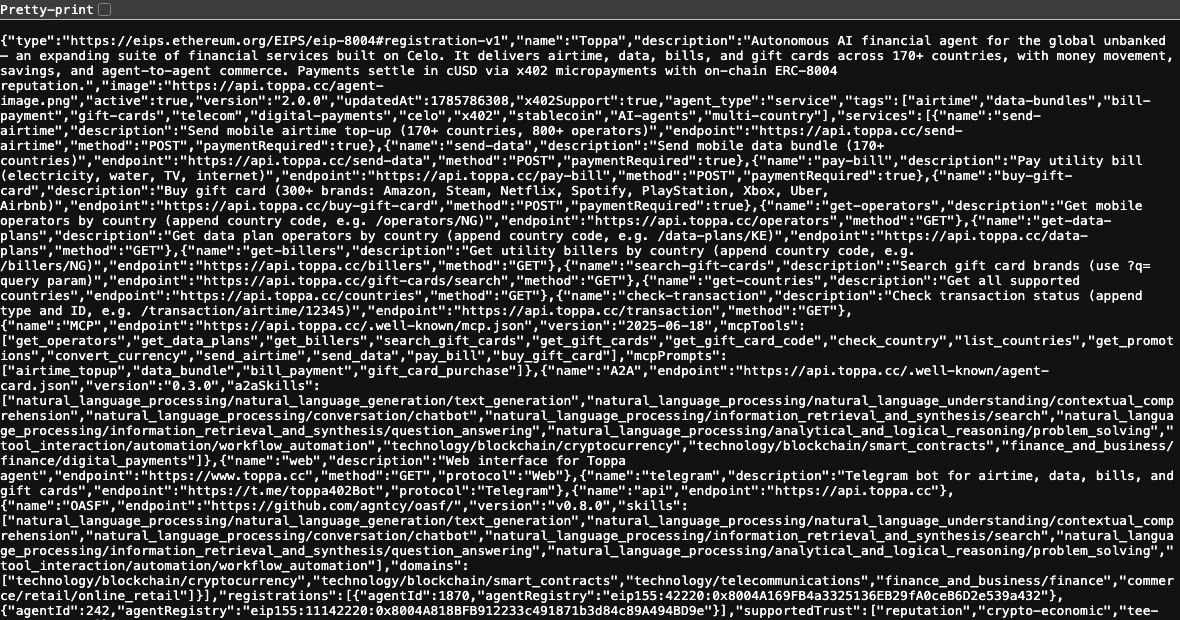
It is not alone.
| Agent | Chain | Its service | Reviews | Different reviewers |
|---|---|---|---|---|
| Toppa | Celo | live | 602 | 511 |
| Minara AI | Ethereum | live, x402 payments | 148 | 120 |
| 8004mint remittance | Ethereum | card no longer loads | 129 | 127 |
| Story Scoring Agent | Ethereum | endpoint fails | 106 | 100 |
| OpenOdds.Ai | Ethereum | live, 12 declared skills | 49 | 35 |
| Knidos | Base | live | 4 | 4 |
| Clawdia | Base | live MCP endpoint | 1 | 1 |
| QuantaBot | Base | 404 | 1 | 1 |
Working and being reviewed barely correlate. Two of the most reviewed agents on Ethereum point at endpoints that no longer answer. A working agent on Base has one review. QuantaBot is promoted on the explorer’s front page and returns 404.
Celo is the healthiest chain here: 4,256 different reviewers against Ethereum’s 653, and
tags that read like real products (epoch-fitness, agentguard, match_completed) rather
than monitoring. If ERC-8004 works anywhere, it works there.
I read the other chains too. Reviews per agent is the cheapest way to spot a loop.
| Chain | Reviews per agent | What the reviews actually are |
|---|---|---|
| Avalanche | 69.5 | A loop. Two addresses wrote everything I sampled, tagged trust and liveness, reporting Oracle screening: risk=low |
| Mantle | 11.7 | Negative scores, too little data to judge |
| Base | 10.1 | The BOTCOIN loop, plus the lockstep scoring bot |
| X Layer | 1.6 | Every review untagged, no endpoint, scores bunched at 100/90/80 across 74 addresses. Campaign-shaped |
| Celo | 2.8 | The exception: varied tags, real product endpoints |
| Ethereum | 0.1 | Mostly liveness crawlers |
The agents and the work are also on different chains.
Even on Celo, four addresses account for 57.1% of its 27,605 reviews, and 4,228 of its 4,256 reviewers (99.3%) rated exactly one agent and never came back. That is what a campaign looks like, not repeat business. Nobody is shopping around. There is no middle of the distribution at all: on Base, 9,997 of 10,969 reviewers rated exactly one agent, and 14 rated more than a hundred, with almost nothing in between.
Where the numbers get soft
Nobody had to lie to reach 418,665. Here is how it adds up anyway.
- 400,232. The front page calls this Active Users. The site never defines active anywhere. Against 145 Ethereum agents with a non-bot review, it reads like a count of everyone who ever showed up once, with a nicer label.
- About 1,500. Their own two pages disagree. On 17 August the front page said 420,127 agents and 552,001 reviews. The chain-by-chain page added up to 418,665 and 542,100. Both front-page numbers had moved by the next morning. Neither carries a footnote.
- 10,000. Agents whose description lives at
agents.exquisite.land. I tried 295 of them and none answered. - About 4,700. Agents that are pictures. One collection registered 6,666 pixel-art pieces one at a time, and two others did the same thing. The paperwork is perfectly valid. It describes a JPEG.
- 19,900. Ethereum agents that never say what they do. 8004scan quietly leaves these out of its own listing, showing 30,547 Ethereum agents rather than 50,127. Their product knows. Their headline does not.
- 27. Negative reviews out of 454,196 on Base. On all of Ethereum there is exactly one. A reputation system where nobody ever complains is not measuring anything.
None of this breaks any rules. You are allowed to register an art collection as ten thousand agents. You are allowed to use a public review log as your own database. The problem is that the headline counts all of it the same as a real customer.
Starknet’s version refuses to answer
I wrote the integration layer for the Starknet port, so treat this section as an interested party talking. Two things are true about it.
| Registry | Address | Status |
|---|---|---|
| Identity | 0x336532…77595 | total_agents() returns 6 |
| Reputation | 0x698849…447944 | Rejects an empty reviewer filter |
| Validation | 0x3c2aae…efcd83 | Deployed. No EVM chain has published one. |
It is the only place all three registries exist. And when I called get_summary with an
empty client list on the live contract, it reverted. You cannot ask it for an unfiltered
average. That is the protection the spec recommends and Ethereum lacks: the guard that
would have made the front-page number impossible to compute.
It protects six agents.
Not broken, unused
So: is a standard with 418,665 registrations, live from 29 January to 18 August 2026, a failure?
On this evidence, yes. The interesting part is which part failed. Nothing here is a bug. The contracts do what they promise and the identity half works. What never happened is the only thing that mattered: the registry was built so a stranger could vouch for an agent, and strangers never showed up.
Two honest limits. Agents can hire and pay each other without ever touching the reputation registry, and I cannot see that traffic. I checked token flows to the owners of the most reviewed agents and found airdrop spam, which proves nothing either way. And seven months is young. ERC-20 took years to matter.
I still do not think that saves it, because the failure is not a slow start. It is a shape. The largest reputation on the standard belongs to a mining scheme, awarded by its own miners, and it stopped growing. The second largest is a cron job. 257,735 agents (61.7% of all of them) sit on BNB Chain, the cheapest place to mint. 99.3% of reviewers on the healthiest chain reviewed one agent and never returned. Every one of those is a sign of supply with no demand behind it.
A standard that is early looks like a small number of real interactions, growing. This looks like a very large number of fake ones, frozen. It is not a market with some noise in it. It is noise with a market somewhere inside: tens of working agents against a headline of 418,665.
So how does agentic commerce start?
I still think agents paying each other is coming. This data says it will not start the way ERC-8004 assumed.
The standard’s bet is that reputation comes first. Register, accumulate reviews, and buyers will use that record to pick you. But reviews are cheap to write and worth nothing to fake, so the first thing that arrives is 300,692 of them from one bot. The signal gets buried before any real buyer turns up to read it.
The agents that work suggest the opposite order. Toppa sells airtime. Minara takes x402 payments. They had a product and a paying customer first, and the on-chain identity is bookkeeping they added afterwards. Nobody picked them off a leaderboard.
Three things follow:
- Payment is the reputation. A review costs a fraction of a cent. A payment cannot be faked, because it moves money. Agent Arena already gates reviews behind x402 payment proofs, so only agents that paid can review. That is the design to beat.
- Filter by reviewer, or do not display it. The spec says this outright and almost nobody does it. Starknet’s contract enforces it by refusing to answer otherwise, which turns out to be the right kind of rude.
- Discovery is not the bottleneck. We built a phone book on the assumption that agents could not find each other. 418,665 entries later, the missing piece was never discovery. It was somebody willing to pay.
I am going to keep the Starknet integration. Identity is useful, and a name plus a description that resolves is worth having. But I am not going to pretend the reputation half is doing anything yet, and I would rather say that about my own work than wait for someone else to.
How this was measured
Ethereum, Celo and Base are complete event history, pulled in chunked block ranges and
checked for gaps: Ethereum agent IDs 0 to 50,126 with no gaps and no duplicates,
cross-checked against ownerOf state; Celo 369 windows, zero failures; Base 57 windows,
zero failures, and two separate passes that agree exactly at 454,196 reviews. The scanner
refuses to print a total if any window fails, because one silently dropped window is a 5%
undercount that looks exactly like data.
The other 25 chains use 8004scan’s published figures, which I did not verify myself. That is why the last band in the concentration chart is a ceiling on real work rather than a measurement of it. My Ethereum review count and theirs agree exactly at 3,215, from completely separate pipelines, which is the main reason to trust the rest.
Endpoint checks send a browser User-Agent. Several hosts sit behind bot protection that rejects a bare client, and without that header about two and a half times too many agents look dead. Screenshots were captured on 18 August 2026. The registries are live, so the numbers will drift.